
The Igikoko: Uncharted
A new journey begins

A boy vanishes into the abyss of a mysterious lake, touching off a frenzied hunt for the murderer aboard the Igikoko, as it continues its nighttime run ferrying innocent passengers and criminals; smugglers and rebels on a dark passage to the South.
Watch for instalments of this work-in-progress serial, every second Friday at 3 p.m., EST; noon PST.
This week, I am releasing two chapters in two separate emails.
Past releases of the Igikoko Uncharted: Chapter 1
Check out my complete story catalog

Watch for the upcoming e-book release.
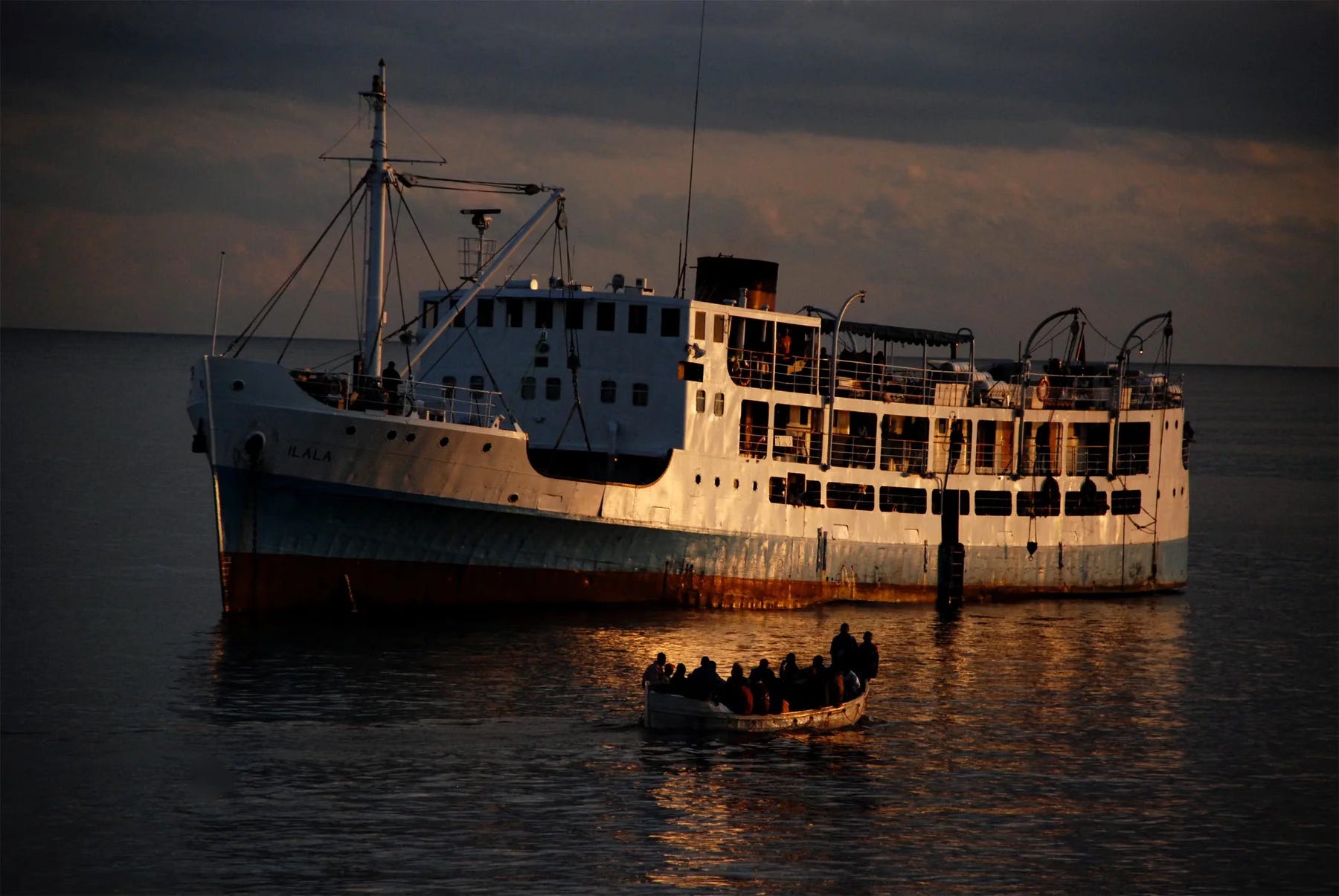
The Igikoko travels the lake at night, ferrying families and transporting criminals north to south and back again, twice a week, every week.
Chapter 2
They greeted the Igikoko up-ramp, Simon’s grip full of shirt, pulling Drisbie on board past security guards and soldiers. They flowed through clean, without question, never looked back.
“Follow the outer walkway round,” Simon pointed to the port-side promenade deck. “Your room is that way.”
The Igikoko, at 60 metres long, boasted two promenades, sweeping front-to-back, one on each side. Sleeping quarters and the kitchen/dining room, were dug out from a single blocky mass clunked down through the ship’s middle.
Simon headed for a metal staircase leading to the upper deck.
“I’m going to make my own place up on the second level.”
“Wait,” Dribsbie said. “Are you hungry?”
Simon stopped. His stomach had shrunk plenty over the last few days. “I could eat,” he said. “But I need to stake out a spot to sleep before too many people come on board.”
“I thought you’d sleep in my quarters,” Drisbie said.
Simon laughed. “No Mister. I don’t go for that kind of thing. Not in your room. No Mister.”
“What? No.” Drisbie pulled away, shocked and hurt. “What do you mean, ‘that kind of thing’? I didn’t mean anything except sleep. What do you take me for?”
Simon never hesitated. “No sir. Thank you. I prefer to sleep outside.”
Drisbie threw up his hands and walked away. Let the little shit find his own place to sleep if that’s how he wanted it.
An hour later, the Igikoko whistle-shrieked and chugged away from the dock, only one hour late and half-full, leaving Simon with most of level two to himself. He made camp near the rail above the aft deck.
He rubbed his stomach. Now that he was settled, he wondered where Drisbie had gotten to. He might take him up on that food offer from earlier.
He waved his head, sniffing the air. The darkening was near, that period when the sun fell like a meteor, transforming the lake into an abyss without end. Twilight skipped over this part of the Earth. The light of the world just blinked out, predictable yet abrupt, until the cold moon crept high enough to light the way for the daytime stragglers caught out and the night creatures.
Simon wiped his nose with the back of his hand, tears wet his face, overwhelmed because he had time to think with this pause in the chase. The police would never find him here and loneliness bedded down.
Papa was lost. Even if he wasn’t dead, Simon was convinced he had to accept the fact that he’d never see him again.
Uncle Gustave lived on, but only as a crutch icon, a cause célèbre in the form of a crocodile to spur protesters to their heroic ends. Uncle Gustave was a legend, never again to assume a fleshy form humans might touch.
Simon rose to watch the final throes of the dying sun. It was a calm evening, he prayed a calm night would follow.
Help me, Mama. Help me. Simon closed his eyes and wished so hard he thought his eyes might squeeze from their sockets. He imagined when he opened them, Mama would be standing next to him.
I am sorry I could not bring Papa home with me, but he was carried off in a tornado of uniforms and rifles and he shouted for me to run.
We never found Uncle Gustave because the police kept him locked away and wouldn’t let us see him. Perhaps he is dead. But you should know, Mama, people shout his name in the streets and wherever they gather. They carry signs with his face on them.
Simon found a tiny space behind boxes of rope and winches, and cried into his hands.
I am ashamed, Mama. I was no help to Papa. We went to the jail to visit Uncle Gustave, to ask about his release. Papa pleaded and promised that if they released your brother into his care, he would cart his body and soul, dead or alive, back home to Runzeri, where he would not bother the President any longer. The fat general with the heartless eyes refused.
I didn’t know what else to do.
You should know, Mama, that Papa rallied the men and women of the Capital to march with him in the government square. You would have beamed to hear them chanting your brother’s name. How they yelled out for Gustave and called him The Great Crocodile, the Terror from the Depths, the One who strikes fear into soldiers’ hearts and sends the President fleeing into the hills.
But the soldiers shot them all. They are all dead. At least, I think they are dead. When Papa yelled at me to run, I ran.
I’m ashamed. I did not behave like a man.
The sun fell off the Earth then, leaving Simon crumpled and sobbing.
He allowed his bout of self-pity, but only for a short time. He had work waiting for him in Runzeri. Papa was gone and he was the man of the house now.
He steeled his courage and stalked down the stairs, searching out a kind cook or a generous passenger who might toss him a hunk of cheese or a piece of fish.
He turned onto the port side promenade and knocked on Drisbie’s door, number 10.
No reply.
He explored, weaving between stretched out legs on the bow. People talked low or sang softly. Beneath the roof created by the upper level, rows of chairs bolted to the forward deck were occupied by women and children and a few older men. Large duffle bags lie at their feet like laundry. A few small charcoal barbecues smoked fish or sticks of grisly meat. They passed around hunks of bread and cheese. Several women held out offerings to Simon, which he accepted and munched as he walked.
He circled back to the port promenade and ducked his head into the entryway of tiny the dining room.
Drisbie sat huddled at a table playing cards with two other men. They were sharing a bottle of something and communicating through loud laughter.
A woman at the door wearing a crimson uniform under an apron shook her head. “No. Kitchen is closed. This is not for children.” She wagged her finger.
Simon assumed she worked in the kitchen, perhaps as an assistant cook or some such, and had been stationed by the door to tell people they were too late for dinner.
The woman squinted and lightly slapped Simon on the side of the head. “Move on.”
Simon faked left, squatted and tried to duck under her arm.
“I know him,” he said. “I know that man, the one wearing the brown shirt. I am with him,” he said.
“I said no,” the woman said. “I don’t think he wants to see you or he would say so.”
She shifted into the centre of the entryway to more fully block Simon’s view.
“Mister Drisbie,” he called. “It’s me. It’s Simon.”
The woman looked over her shoulder, checked Drisbie’s reaction, then pushed the boy out. “See. He does not wish to see you.”
Simon turned, disappointed but not surprised.
Lazy, drunk men cared only about their stupid games, he thought.
He walked toward the back, to the sleeping place he’d set up at the upper deck where at least there were no loud men.
After Simon left, Drisbie paused the card game for a beat.
Dammit, he felt guilty for ignoring the poor kid. He’s probably starving, but Drisbie would be crazy to step away from the table in the middle of a hot streak. He’d check with Simon later. Maybe take him some food.
Besides, he didn’t even know him, he thought. The boy wasn’t his responsibility.